From the public record · March–May 2025
What I did during the crash: the 2025 tariff drawdown, in real time
A dated public record of the April 2025 tariff crash: the copier briefing written at maximum fear, fresh capital deposited into the fall, the Palantir buy at $67 — and why position sizing, not prediction, made every decision possible.

Originally shared on Tony's eToro feed · 3 April 2025 · view the original post
On the morning of 3 April 2025, I sat down and wrote the most uncomfortable post I had ever published.
The day before, the White House had announced a sweeping new tariff package. Global markets were selling off hard. My portfolio was deep in the red, close to two hundred people were copying it with their own money, and I did not know what was going to happen next.
I want to be precise about that last part, because it is the point of this article. I did not know. And because I invest in public, I can prove it — everything below is put together from posts I published while it was happening, with their original dates. I have not cleaned up my reasoning to make it look smarter than it was. Where I was uncertain, the uncertainty stays. Where I was wrong, that stays too.
This is not a story about calling a bottom. I didn’t call it. It is a story about what a portfolio built for uncertainty looks like when the uncertainty actually arrives.
Before the worst of it
The crash didn’t come out of nowhere. The first quarter of 2025 had already been rough — trade-war headlines had been building for weeks, and my portfolio had started the year badly.
Two things from that period matter for what came next.
First, on 12 March, I made a positioning decision that had nothing to do with predicting a crash: I closed my crypto positions and rotated the capital into Tesla and Palantir, two businesses I had long-term conviction in at prices I thought were already discounted. By late March that rotation was working, and I said publicly I was convinced the portfolio would be back at all-time highs by mid-year. That call is on the record — it was conviction, not knowledge.
Second, by the end of March I was openly worried about the technical picture.
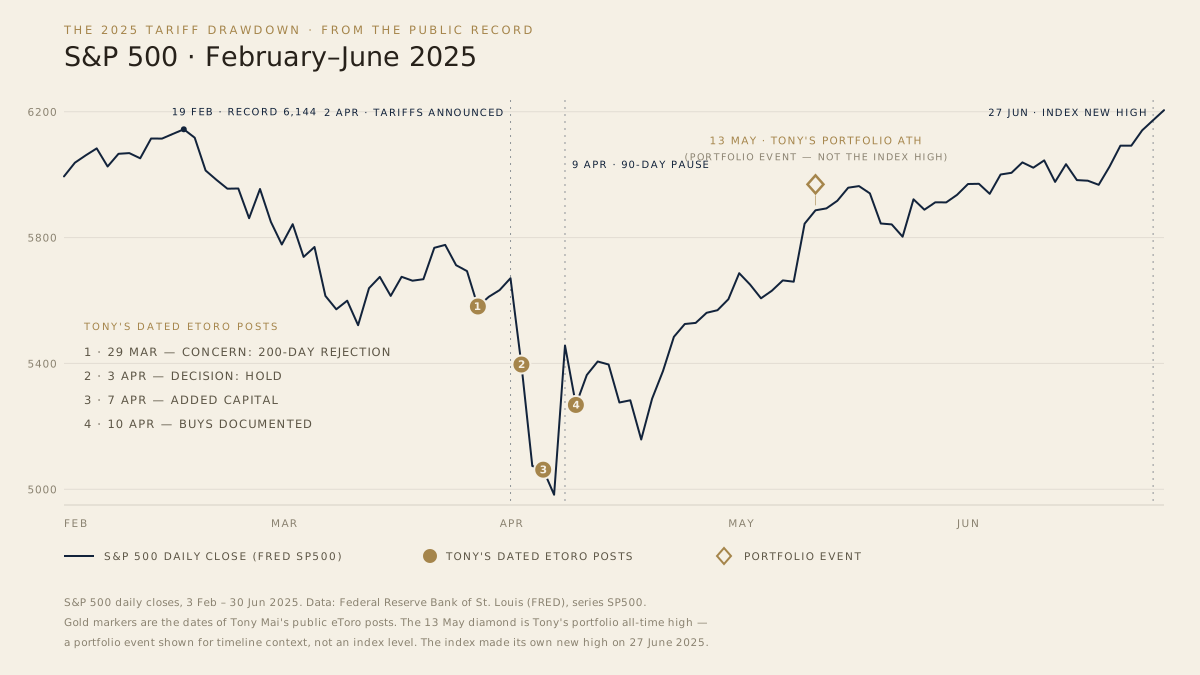
29 MARCH 2025 · FROM THE PUBLIC RECORD Both the S&P 500 and the Nasdaq had rallied into their 200-day moving averages — and been rejected. “This strong resistance got rejected convincingly on both the indexes, which is worrisome… I have not seen this much volatility since the pandemic in 2020.”
I wrote that weekend that I was concerned in the short term and calm about the long term, and that I was personally looking to add — “investing is a game of patience with long duration.” Four days later, the patience part got tested properly.
3 April: maximum uncertainty
The tariff announcement landed on the evening of 2 April. The next day, with markets in freefall, I published an urgent briefing to the people copying my portfolio. Reading it back now, most of it is about what I couldn’t know.
3 APRIL 2025 · FROM THE PUBLIC RECORD “Now, the real question comes down to: does the market tank further from here, and when will the bleeding stop? I honestly wish I had a crystal ball to predict the future but unfortunately, I do not. If I told you that I knew the answer to that, then that would be a lie.”
The decision I announced was to do nothing — to hold. Not because I believed the fall was over. In the same post I wrote, plainly: “Could our portfolio fall another 10–20 percent? Sure, it could.”
The reasoning was about a different question entirely. The alternative to holding was to sell and try to buy back lower — and I had been through enough cycles to know how that actually plays out:
3 APRIL 2025 · FROM THE PUBLIC RECORD “Can anyone even predict where the bottom is? If you sell and the market goes back up, how do you get back in? Mentally, it would be a tough buy at a higher price from what you sold.”
Selling in a panic doesn’t just need one good decision. It needs two — the exit and the re-entry — both made against your own emotions, right when sentiment is at its worst. I had been through three booms and busts by then, and all three times the money was made by holding through and adding, not by jumping in and out.
So the plan, written down at maximum fear, was: hold, expect it to possibly get worse, and treat further falls as opportunities. Nothing in that plan depended on knowing where the bottom was.
7 April: adding while it was still falling
The selling accelerated. Over the two sessions after the announcement, the S&P 500 fell more than ten percent — one of its worst two-day stretches in decades. By Monday 7 April, US index futures were in freefall at the open, and the index briefly touched twenty percent below its February peak during the session. That morning I deposited fresh capital into the portfolio — about 7.5% on top of what was already there — and started deploying it.
7 APRIL 2025 · FROM THE PUBLIC RECORD “Can the market capitulate further? Absolutely… It could go down for the next few weeks or it could go up tomorrow. I would rather be early than late! Worst case, if the market tanks another 10%, then I will continue to load more, and so forth.”
I want to be careful here, because this is the part of the story that gets romanticised. Buying that morning was not brave, and it was not clever timing. It was affordable. That is the whole secret, and it is far less exciting than it sounds.
I could add money during a crash for one reason: the money I had in the market was money I did not need, and the money I added was money I did not need either. No leverage. No obligations depending on the portfolio. Nothing that could force me to sell at the bottom. When nothing can force your hand, a 20% fall stops being an emergency and becomes a price.
That condition wasn’t created during the crash. It was created years earlier, when I decided how much of my capital belonged in markets at all.
8 April: the framework, written down
The next day I posted the shortest version of my crash playbook. Four lines:
8 APRIL 2025 · FROM THE PUBLIC RECORD “Set and forget. Stay calm and don’t panic. Stick to your investment strategy. DCA or buy the dip. The easiest way to achieve this is not to OVER-invest… Once you understand this principle, you will never fear a red day again.”
I’m not going to present those four lines as universal rules, because they aren’t. They are downstream of the one condition that makes them possible — the last line. “Stay calm” is useless advice to someone who has their emergency fund in growth stocks. Every line of that playbook works only if the sizing was right before the crisis started.
The same day, the market bounced, and my honest reaction is also on the record: “The recovery is real! … Hopefully it’s not a dead cat bounce.” Even inside the bounce, I didn’t know. What I could not have known was that the following day, 9 April, most of the tariffs would be paused for 90 days and the S&P 500 would rise about nine and a half percent in a single session. My plan did not predict that. It just made sure I was still in my seat when it happened.
10 April: the decisions, documented
With the bounce underway, I posted an accounting of what had actually been done — and what came next.
The buys were real and dated: I had been adding to Tesla through the selloff, and I added Palantir at $67. That fill happened to land close to Palantir’s April low — but that wasn’t something I knew at the time, and nothing about it was precision. I was buying because the prices were far below my estimate of long-term value, with capital I could afford to leave there for years, knowing the market could go lower first.
The same post made a forward call that is worth preserving precisely because it was a prediction and not a report:
10 APRIL 2025 · FROM THE PUBLIC RECORD “Our next strategy is to take profits from some of our Tesla positions and rotate into Alibaba and JD. I believe the United States and China are on the path to reaching agreements… the world’s two largest superpowers won’t risk damaging their economies for the sake of pride — both sides are seeking a win-win outcome.”
That was a view about how the standoff would resolve, held with real money, a month before anyone could know.
What happened next
I’ll keep this part short, because the outcome is context, not the argument.
The market never returned to its April lows. On 12 May, the United States and China announced an agreement in Geneva that cut tariffs sharply on both sides for 90 days, and markets surged — the resolution my 10 April post had positioned for. By 30 April my portfolio was already back to green for the year. On 13 May — about five weeks after the low — it closed at a new all-time high, weeks before the index reclaimed its own high in late June.
For scale: the S&P 500 briefly touched 20% below its February peak on 7 April. My own path in had been rough too — the published monthly record has my portfolio down about 15% from its January peak by the end of March, before the worst week had even arrived. The intraday bottom cut deeper than any month-end number shows; I’m deliberately not putting a precise figure on it, because the monthly record doesn’t capture it and I won’t guess.
Five weeks from the bottom to a new high. It reads like vindication. Be careful with that reading.
What this episode actually taught me
The tempting lesson is “buy every crash, it always comes back.” That is not the lesson, and I want to push back on it directly, because 2025 was in one specific way an easy test: the shock was a policy decision, and policy decisions can reverse in a week. This one partially did, seven days after it was announced.
Now run the counterfactual honestly. Suppose there had been no pause on 9 April. Suppose the tariffs had stuck, earnings had rolled over, and the market had ground down for eighteen months the way it did in 2000–2002 or 2008. Every post I wrote in early April would look very different in hindsight — the 7 April deposit would have been early by a year, “I will continue to load more” would have meant averaging down through a long bear market, and the mid-year all-time-high call would have been plain wrong.
Here is the thing: the plan still survives that version. Not profitably — in that world, the first year looks bad — but financially and psychologically. Because the honest version of the lesson is this:
Position sizing bought the rationality. I was able to think clearly while prices were falling because no outcome — including the bad one — could ruin me or force my hand. The decisions people admire in a crash are made possible by a much duller decision taken years earlier: never putting yourself in a position where the market can make you sell.
Three smaller lessons sit under that one. Writing the plan down before the worst of it — publicly, in my case — made it much harder to abandon in the moment. Admitting uncertainty out loud (“I do not have a crystal ball”) turned out to be a strength, not a weakness: I never had to defend a prediction, only a process. And holding was not passive — it was an active decision, re-examined in writing at every stage, that the businesses I owned had not changed even though their prices had.
The record is the point
Anyone can tell you crash stories after the market has recovered. The reason I can tell this one differently is that every step of it — the worry in late March, the briefing at maximum fear, the deposit into the fall, the buys, the wrong-looking moments and the calls that resolved — sat in public, dated, while it was happening. My track record carries the numbers; this is the thinking that produced them, preserved as it was thought.
Markets will do this again. I don’t know when, and I won’t know then either. What I can do is what I did in April 2025: size positions so that no crash can force my hand, write the plan down before it’s needed, and make decisions I’m willing to be judged on in real time.
That’s not a prediction machine. It’s a process built to survive not having one.
Every dated excerpt above is quoted or faithfully condensed from my public eToro feed, March–May 2025. Nothing has been edited to improve the record.