From the public record · June–August 2026
I didn't change my mind about SpaceX. The price changed.
In June 2026 I published the case for not buying the SpaceX IPO — then started buying the next trading session. The full decision record: the no that was really a price condition, the early buys that broke my own rule, the collapse that made my $142 average, and the objection I never resolved.

Originally shared on Tony's eToro feed · 17 June 2026 · view the original post
On 17 June 2026 I published a post titled “Why I Didn’t Buy SpaceX.”
The next trading session, I bought SpaceX.
I want to write this record down properly, because it’s easy to tell a flattering version of it — the disciplined investor who said no to the hottest IPO in history, waited calmly for the crowd to overpay, and picked up the shares later at a sensible price. Parts of that version are even true. But my own account shows the parts that aren’t, and those parts are the reason this is worth writing at all.
Every step is dated and public, and the numbers below come from my broker statement and the market record.
The no
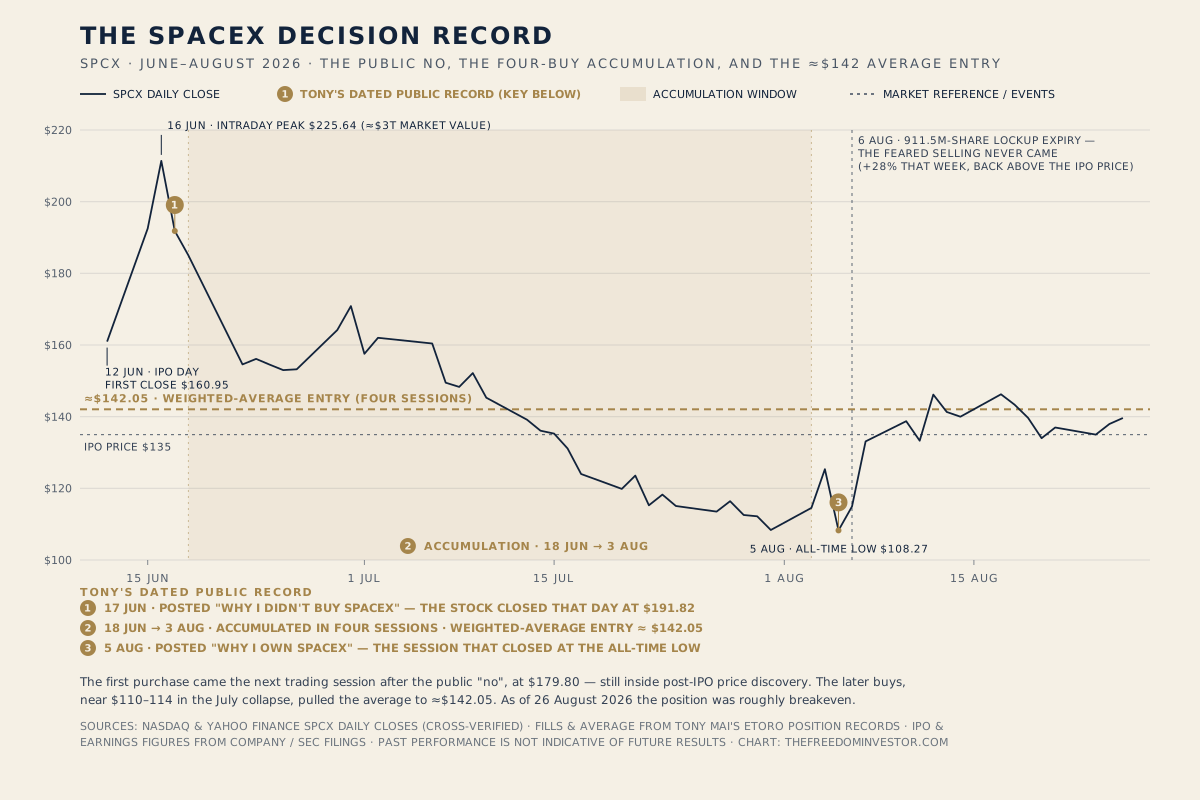
SpaceX went public on 12 June 2026 at $135 a share — the largest IPO ever priced. It opened its first session at $150 and closed at $160.95. Two trading days later it touched $225.64, a market value near three trillion dollars, briefly making it one of the most valuable companies on earth. It had been a public company for three days.
The next morning I posted the “no.” It’s worth quoting what I actually objected to, because none of it was about the company:
17 JUNE 2026 · FROM THE PUBLIC RECORD “I think it’s an incredible business. Few companies have changed an industry the way SpaceX has… Yet despite that, I haven’t bought the stock. The first reason is simple. I rarely buy IPOs. The period following a listing is often driven by excitement, momentum, and speculation… I’d rather let the dust settle. The second reason is valuation. At its current valuation, SpaceX is already being priced as one of the most valuable companies in the world… The third is a portfolio consideration. $TSLA remains one of my largest holdings… I already have significant exposure to Elon Musk’s vision, leadership, and ability to execute.”
And one sentence at the end that turned out to be the whole story:
“If the valuation becomes more attractive in the future, I’ll reassess.”
Read it carefully and it was never a verdict on SpaceX. It was a refusal to chase — a no to a price, with the conditions for a yes written into it. I meant every word.
The record is less flattering than the memory
Here is what the memory says: I waited for the excitement to fade and bought the weakness.
Here is what the record says: my first purchase was the very next trading session, on 18 June, at $179.795 — about six percent below where the stock had closed on the day I published, four trading days into the listing, well inside the price-discovery window my own post had just warned about. A second buy followed on 22 June near $170.
I could dress that up as “reassessing after the valuation became more attractive.” Twenty percent off the peak is not nothing. But six percent below the price I’d publicly declined to pay, one day earlier, is not a changed valuation — it’s a test of how strong the pull of a great company is, and the honest answer is: stronger than my own post. The dust I said I’d wait for had not settled. More than half the money I would eventually put into SpaceX went in during those first two buys, and both were underwater within three weeks — at the bottom, badly so.
If you want a lesson from this piece that costs me something to write down, it’s this one: publishing your discipline doesn’t make you disciplined. The no was real. It just held for about forty-eight hours against a twenty-percent dip in a company I admired.
The collapse that made the average
Then the market did what I’d originally said it might, except to me as well.
Through July, SpaceX went from post-IPO darling to one of the most shorted names in the market. Yields rose, AI leaders sold off, and the stock fell through $150, through the $135 IPO price, and kept going — by 27 July it closed at $113.50, more than a trillion dollars below its June peak. The concern wasn’t the business. Second-quarter revenue, reported on 4 August, came in at $7.8 billion, up ninety-two percent, well ahead of expectations; Starlink subscribers had doubled in a year. What spooked the market was $18.4 billion of quarterly capex — and, hanging over everything, the first share lockup expiry, when 911.5 million insider shares would become saleable into a public float about a third that size.
This is where the record reads better. I bought a third time on 23 July near $114, and a fourth on 3 August just under $110. That last one deserves its own honesty label: it was the day before the company’s first-ever earnings report, and it landed within a few percent of what turned out to be the absolute low. Buying in front of a maiden earnings print isn’t patience — it’s a bet, and it happened to pay. The proximity to the bottom was luck. Both go in the ledger as what they are.
On the morning of 5 August — which became, by the close, the stock’s worst day and its all-time low of $108.27 — I published the companion post:
5 AUGUST 2026 · FROM THE PUBLIC RECORD “Most people still think of SpaceX as a launch company. I see a business building multiple long-term cash flow engines… That doesn’t mean there aren’t risks. The valuation already reflects enormous expectations, capital spending remains exceptionally high, and execution needs to stay world class.”
That timing looks like conviction under fire. It half was. It was also, on the numbers, a position that had done nothing but lose money for six weeks.
Across those four purchases — two too early, two into the collapse — my weighted-average entry came to about $142. For its first three weeks as a public company, SpaceX never closed below $153. The average ended up below any price the market offered during the entire post-IPO excitement, and thirty-seven percent below the peak I’d refused to pay. Not because any single decision was clever, but because the later, cheaper buys did the repair work the early ones needed.
The average tells the story of the position. The individual fills tell the story of my decision-making.
What happened to each objection
The IPO rule — let the dust settle — was right about the world and only half-obeyed by me. The stock did spend two months finding its price, 50% peak-to-trough. The rule kept me from paying $190–225. It did not keep me out of price discovery, and it didn’t need to be perfect to matter: it needed to keep the average sane, and it did.
The valuation objection answered itself. At my average entry the company was priced about a third below where I’d called it fully valued. The objection didn’t vanish — even at the lows this was a company priced around one and a half trillion dollars, with enormous expectations embedded — but “a lot of future success already reflected in the price” was a much weaker sentence at $142 than at $210. The company didn’t need to change. The price did.
The Musk overlap is the objection I never resolved — and I should say that plainly. Nothing I did between June and August reduced it. I kept Tesla. I added to Tesla during the July selloff. I bought SpaceX, then added to both in August. And on the day of the lockup, Tesla and SpaceX jointly announced Terafab, a $16.8 billion shared chip fab — the two companies became more entangled while I was buying, not less. What I can honestly say today is that I own both because I believe in each on its own terms, and — a current view, not something I believed in June, and not a prediction — I’ve come to think the two businesses are converging strategically, perhaps someday all the way. Nobody knows whether that happens. What the record shows is simpler and less comfortable: I flagged the concentration risk in writing, and then I knowingly increased it. That line of my June post wasn’t overturned by events. It was outweighed by conviction — and if the Musk ecosystem ever has a very bad year, this is the paragraph I’ll be rereading.
Epilogue: the week the fear failed
The lockup itself became the sequence’s final exam — for the market, not for me.
Everyone knew the risk: 911.5 million shares, worth over $100 billion, becoming saleable on 6 August, days after an all-time low. The selling flood was the most telegraphed event of the summer. It never came. The stock rose six percent on the day, and within a week it was up roughly thirty percent from the lows, back above its IPO price — helped along, honesty requires me to add, by more than the non-flood: the Terafab announcement landed the same day, an analyst upgrade followed, and a heavily shorted stock did what heavily shorted stocks do when the bad thing doesn’t happen.
I wrote at the time that markets don’t move on whether news is good or bad, but on whether reality is better or worse than what’s already priced in. I’d learned that lesson the expensive way before. The June euphoria and the August fear were the same error with opposite signs — both were confident prices for futures that hadn’t arrived. The company barely changed all summer. The price halved and recovered.
What I keep from it
A no to a price is not a no to a company. The most useful sentence in my June post was the reassessment clause. If you write down a no, write down what would change it — otherwise your no is just a mood with a timestamp.
Expect your own no to be tested immediately. Mine lasted one trading session against a great company on sale. What made that failure survivable wasn’t the first purchase — it was the three that followed it. I didn’t stop at $180; the two buys made near $110–114, into the ugliest stretch of the decline, are what pulled the average down to a price I’d actually been willing to pay all along.
The average became my entry price. How I got there matters just as much. Judged fill by fill, this record contains two mistakes, one bet, and one decent buy. Judged as a position, it’s an average of $142 on a company I wanted to own, built through a fifty-percent collapse without breaking. As of 26 August 2026, that position is roughly breakeven — the honest scoreboard of the whole episode is that the best decision in it remains the public no at $210, and the money I actually made so far is approximately nothing. Whether the yes was right, only the next decade gets to grade.
My record of all of it — the no, the too-early yes, and everything since — is public.
Dated excerpts are quoted from my public eToro feed, June–August 2026. Purchase dates, fill prices and the ~$142 weighted-average entry are from my eToro position records; market prices, IPO terms, earnings figures and lockup mechanics are from primary and contemporaneous sources. The Tesla–SpaceX convergence remark is a present-day view recorded in August 2026, not part of the original June reasoning.