Insight · Company analysis
Owning Tesla: how my largest position earns its place
Tesla has been at or near the top of my portfolio for most of two years. This is the part almost nobody writes down: not the thesis, but the handling — the trims, the reloads, the 18% concentration cut, and the rule that the thesis decides whether a position exists while the market decides how big it gets to be.

Tesla is the largest position in my portfolio as I write this, in August 2026, and it has sat at or near the top of it for most of two years.
On its own, that isn’t very interesting. The case for and against owning Tesla has been argued to death — by me included, and my version lives on the Robotics thesis page, where it’s re-checked twice a year rather than whenever I feel like it. What almost nobody writes down is the other half: what owning a position like this actually involves. The trims. The reloads. The stretch where it grew too big and had to be cut. The timing call I got plainly wrong. Every one of those decisions is dated and public, which means this article can show you the handling instead of just describing it.
The rule that runs through all of it is simple, and it’s the real subject of this page: the thesis decides whether the position exists; the market decides how big it gets to be.
What I think I own
First, briefly, the thesis — because the sizing decisions make no sense without it. I don’t hold Tesla for next quarter’s deliveries. I hold it as an AI, autonomy and robotics platform with a car business attached, where the car business funds the attempt. In May 2026, with the position at 12.7% of my portfolio, I put it in one post:
1 MAY 2026 · FROM THE PUBLIC RECORD “My long-term thesis rests on three big bets: Autonomy (FSD + Robotaxi)… Optimus… Energy storage — a growing, high-margin business that provides stability while the higher-upside bets mature. Tesla’s real advantage is its massive real-world data from millions of vehicles… Of course, risks are real: valuation is stretched, EV competition is intense, and many of these initiatives will take years.”
Three bets, one funding engine, one data moat. The structure hasn’t changed since I built the position; what changes is the evidence underneath it, and autonomy is where the evidence has moved most. In June 2025 the robotaxi service launched in Austin as a supervised, invite-only experiment. Fourteen months later it was running rides with no safety monitor in the car, and Cybercab — the purpose-built two-seater with no steering wheel — had entered production ahead of its September 2026 Austin launch. You can argue about the pace. You can’t argue it’s standing still.
The most convincing signal didn’t come from Tesla at all:
22 JANUARY 2026 · FROM THE PUBLIC RECORD “Lemonade just announced they’re slashing insurance rates by ~50% for Tesla drivers when FSD is engaged… Insurers don’t just hand out 50% discounts because of marketing fluff. Premiums follow risk and claims.”
Marketing can inflate a narrative; an underwriter can’t afford to. When the business of pricing risk cuts the price of FSD-driven miles in half — verified mile by mile through Tesla’s own API — that’s worth more than any keynote. Subscriptions have followed, from 1.1 million at first disclosure to nearly 1.5 million by mid-2026.
Optimus, by contrast, I hold at promise-weight, not proof-weight — whether humanoid robots can do useful work at all is exactly the question the robotics thesis exists to keep honest. And energy storage is the quiet third bet: a real, growing business that asks nothing of the science fiction. That’s the whole case as it stands; for the full argument and the condition my view depends on, read the thesis page.
What the sceptics get right
Here is the other column, from my own record.
The valuation prices in wins that haven’t been won. I said so myself in August 2026: much of Tesla’s value “has existed as a promise about the future.” A promise, at a premium. That’s what I own, and pretending otherwise would be the beginning of losing money politely.
The stock spends years going nowhere. From late 2021 through 2024, Tesla produced enormous narrative swings and, zoomed out, a share price that went broadly sideways. I held through a long stretch of that, and as I wrote at the time: the middle of a great investment rarely feels like one. If you need the market’s weekly agreement to stay invested, this is the wrong stock.
I’ve been wrong about it — on the record. In March 2025 I called the chart a “perfect setup” with a “potential ATH in 9 weeks.” Nine weeks later the stock was still roughly thirty percent below its old high. Whatever happened to the longer-term thesis, my timing call was noise, and it’s preserved in public like everything else.
The key-man risk is not theoretical. On 5 June 2025, a public feud between Musk and the White House knocked fourteen percent off Tesla in a single day — roughly $150 billion, its biggest one-day loss of market value — over something that had nothing to do with cars, robots or energy. Owning Tesla means carrying that. It also means being honest that my Musk exposure is concentrated: it’s one reason I was slow to add SpaceX when it listed, and I said so at the time.
And the hype pays less than it promises. My carefully-managed trade around the robotaxi launch itself netted about three percent. In July 2026, deliveries came in well above expectations — and the stock fell the next day. This is a company where the future gets priced first and questioned later, in both directions.
How I actually hold it
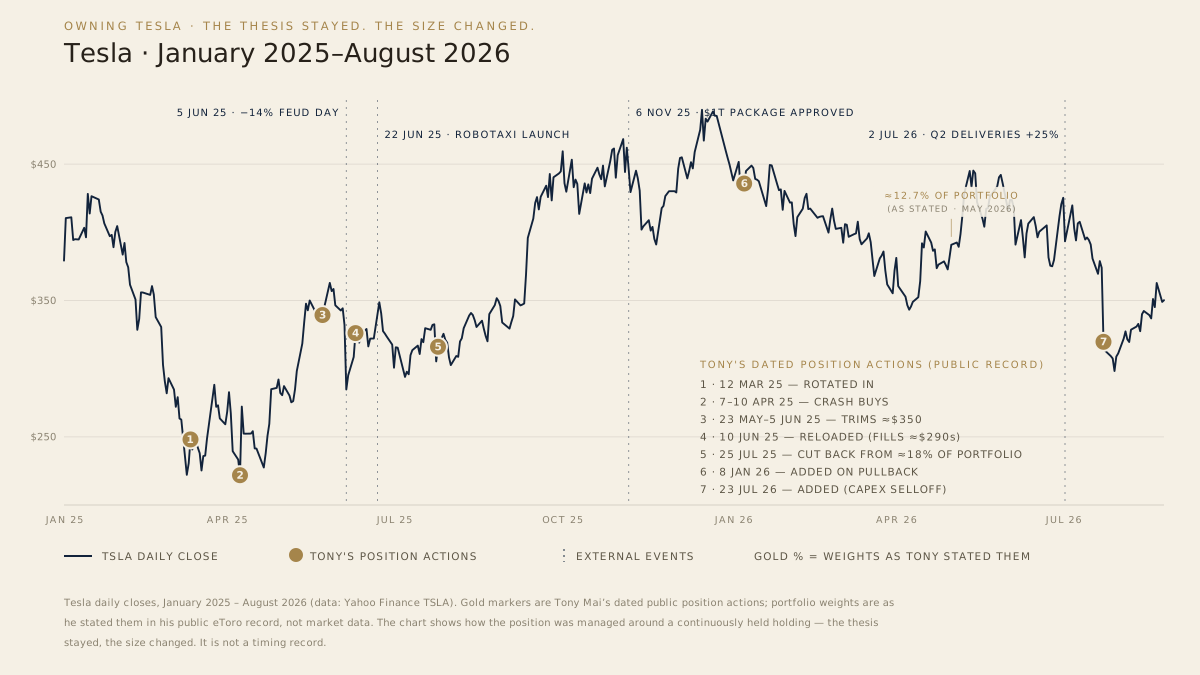
This is the centrepiece, because it’s the part conviction investing usually gets wrong. People treat conviction as a reason to freeze. My Tesla thesis has been essentially fixed for two years. The position has almost never stood still. Here is the ledger, from the public record:
March 2025 — rotated in: closed my crypto positions and put the capital into Tesla and Palantir at prices I thought were already discounted.
April 2025 — added through the tariff crash, with fresh capital, while the market was in freefall — a story told properly elsewhere.
May–June 2025 — trimmed into the robotaxi excitement, around $350, announced before the event: buy the rumour, sell the news, said out loud in advance.
June 2025 — days later the Musk–White House feud crushed the stock. I read it as sentiment damage, not thesis damage — nothing about the businesses had changed — and reloaded in the $290s as a labelled short-term trade.
July 2025 — the position had ballooned to roughly 18% of my portfolio. I cut it back hard. Not because I liked Tesla less: because no single position is allowed to own me, whatever I think of it.
January 2026 — added on an oversold signal during a pullback.
July 2026 — added again when the market punished AI capital spending, funding it by trimming weaker holdings.
Read the two columns of that ledger separately. The thesis column barely moved between March 2025 and today — the same three bets, restated almost word for word across eighteen months of posts. The size column never stopped moving: up on evidence and weakness, down on hype, concentration and event risk, breathing between roughly a tenth and — briefly, before I corrected it — nearly a fifth of the portfolio. (For precision: “at or near the top” is the honest phrasing, because for a stretch in late 2025 Palantir’s run actually made it my largest holding until I trimmed it. The record shows that too.)
None of this was perfectly timed, and that isn’t the claim. The robotaxi round trip made three percent. The reload could have been early; the rebalance gave up upside when the stock kept running. The claim is narrower and more useful: conviction stayed attached to the thesis, and size stayed attached to risk — to price, to concentration, to how much of the value was still promise, to what a fourteen-percent Tuesday does to the whole portfolio. Conviction answers “should I own this at all?” It is a terrible answer to “how much?”
People ask whether trimming a conviction holding means the conviction is fake. I’d put it the other way: a position you can never trim is a position that has stopped being a decision.
The test starts now
For two years, owning Tesla meant owning a mostly unproven story, and the sceptics were entitled to their column. What’s different now is that the story has begun producing checkable results: deliveries growing again — 480,126 in Q2 2026, up 25% on the year, the first annual growth after two years of decline — a robotaxi service running without safety monitors, a purpose-built vehicle entering production, and an insurance market repricing the software’s risk in Tesla’s favour.
None of that settles it — the full autonomy and robotics case remains unproven, and margins, regulation, competition and execution can still break it. The thesis page carries what would make me wrong. But the question I set out in public in August 2026 is the honest frame for the years ahead:
21 AUGUST 2026 · FROM THE PUBLIC RECORD “I’m not assuming Tesla has already won autonomous driving. It hasn’t… But investing is about watching the direction of travel… The next few years should tell us whether the market has been pricing in a fantasy, or simply pricing in the future early.”
Until the evidence answers that, Tesla stays what it has been all along: my largest position — held on a written thesis, sized by rules that don’t care how excited I am, and managed in public where you can check every move against the record.
Dated excerpts and every position action above come from my public eToro record, March 2025 – August 2026. Position sizes are as I stated them at the time; company figures are from Tesla’s disclosures and other primary sources, correct as of late August 2026.