From the public record · May–July 2025
Buy the rumour, sell the news: my robotaxi trade, start to finish
In summer 2025 I traded Tesla's robotaxi launch almost exactly to a plan announced in advance — and made three percent. The full anatomy of an event trade: the pre-commitment, the luck I didn't earn, the prediction that missed, and what event trading honestly pays.

Originally shared on Tony's eToro feed · 14 May 2025 · view the original post
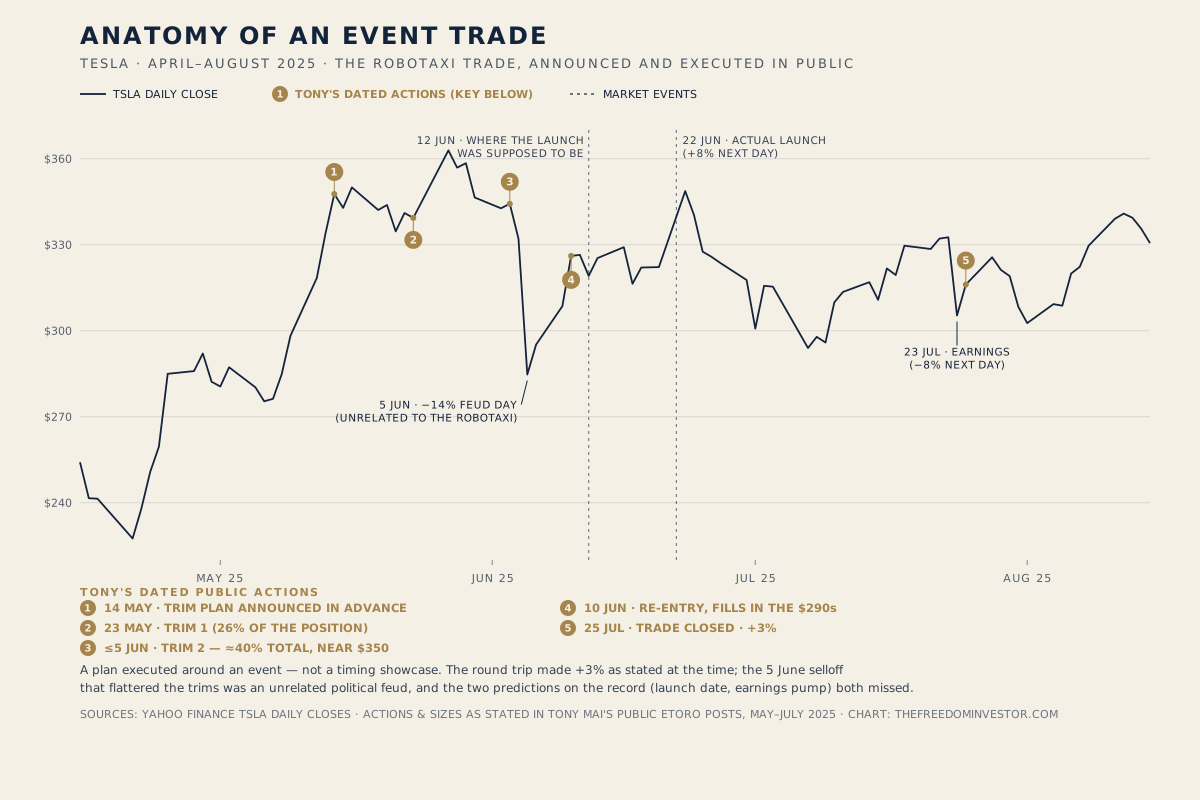
In the summer of 2025 I ran a trade almost exactly according to a plan I’d published in advance — and made three percent.
I want to write that trade down properly, because it’s the most instructive kind of result there is. Not a disaster with an obvious moral. Not a win worth bragging about. A trade where I read the pattern correctly, announced the plan before the event, executed it on schedule, got one prediction badly wrong along the way, benefited from luck I didn’t earn — and walked away with a small number and a much clearer idea of what event trading actually pays.
Every step is dated and public. Here it is, start to finish.
The setup: an event everyone could see coming
By May 2025, Tesla’s robotaxi launch was the most anticipated event on the company’s calendar. I owned Tesla as a long-term conviction holding — how that position is managed across years is its own story — and I believed in the significance of the launch as much as anyone. I’d written days earlier that a working robotaxi network could eventually make Tesla “a platform, not just a carmaker.”
That’s precisely why I planned to sell some.
A known event with a date on it doesn’t get priced when it happens; it gets priced in the weeks of anticipation before it. By the time the thing everyone is excited about actually occurs, the excitement is often already in the share price — and the event itself becomes the moment the buyers run out. Markets don’t move on good or bad; they move on better or worse than what was already priced in. “Buy the rumour, sell the news” is the shorthand, and this was as clean a set-up for it as I’d ever had in a position I owned.
So I said what I was going to do before I did it:
14 MAY 2025 · FROM THE PUBLIC RECORD “I’m planning to trim back my $TSLA holdings toward the end of May, just ahead of the much-hyped Robotaxi rollout in June… this has all the signs of a classic ‘buy the rumor, sell the news’ setup. Time to lock in some gains and stay flexible.”
Announcing a plan in public does something useful to you: it converts a vague intention into a commitment with a date on it. When the excitement peaked two weeks later, the decision was already made — I just had to execute it.
Execution — and a piece of luck I didn’t earn
I trimmed in two rounds: about a quarter of the position on 23 May, and more in early June, roughly forty percent in total, at prices near $350. In the same post I wrote down the other half of the plan before it was needed:
5 JUNE 2025 · FROM THE PUBLIC RECORD “I personally trimmed around 40% of my position in two rounds near the $350 mark — that was right before this sell-off… I’m eyeing the 200-day moving average around $300 as potential support. If the stock finds its footing there and shows some rebound momentum, I’ll be looking to re-enter.”
“Right before this sell-off” is the part that needs honest handling. On 5 June — days after my final trim — a public feud between Musk and the White House knocked fourteen percent off Tesla in a single session. My trims suddenly looked clairvoyant. They weren’t. I had sold because of the robotaxi calendar; the stock fell because of a political fight nobody saw coming. The plan put me in the right place, and luck made it look like twice the plan it was.
I think labelling that matters more than most investors realise. If you bank luck as skill, you will eventually bet real money on skill you don’t have. The honest scorecard for those trims is: right idea, right execution, and a bonus I did nothing to deserve.
The re-entry, at least, was all plan. The stock found its footing near the level I’d written down, and on 10 June I reloaded — fills in the $290s, labelled at the time as a short-term trade sitting on top of the long-term core.
The event that moved, and the pump that came anyway
Here’s a detail I’d forgotten until I re-read my own feed: even the event was a rumour. On 2 June I posted that the launch was set for 12 June — which was, at the time, Tesla’s actual target. It slipped. The service launched on Sunday 22 June instead: invite-only, a handful of Model Ys, a flat $4.20 fare, safety monitors on board. If your trade depends on an exact date, you’re not trading the event — you’re trading the press release about the event, and press releases get revised.
The next day the stock jumped about eight percent, and I was as caught up in it as anyone — my post that morning declared that “the robotaxi era has begun.” The rumour had been bought, the news had arrived, and for once the news got bought too.
Which left one decision: when to take the trade off. Into July’s earnings, I made a prediction — and it’s the most useful sentence in this whole story, because it was wrong:
23 JULY 2025 · FROM THE PUBLIC RECORD “I personally think we might see a slight miss on the numbers… but if history repeats, Elon will likely say something super bullish on the call — and the stock could pump on sentiment alone. If we get that post-earnings run, I’ll likely be trimming back some of our Tesla position.”
There was no pump. The stock fell about eight percent the next day. My exit scenario — trim into post-earnings strength — never arrived.
I closed the trade anyway.
25 JULY 2025 · FROM THE PUBLIC RECORD “Yesterday, I trimmed about 45% of our $TSLA position — not just because of the earnings call, but because I decided to close out our recent robotaxi trade. Despite the −8% drop, we still locked in a +3% gain on that trade. Not perfect, but in this game, we take the small wins and move forward.”
The trade was always ending around earnings. The prediction about how it would end was wrong; the ending happened regardless. That’s the whole difference between a plan and a prediction: a prediction has to be right to help you, a plan just has to be followed.
What the trade actually paid
Now the uncomfortable arithmetic, because this is the part the phrase “buy the rumour, sell the news” never tells you.
I identified the right event. I named the right mechanism, in public, in advance. I sold near the top of the anticipation, re-entered near the bottom of an unrelated panic, and held through the launch pop. About as well as I could reasonably have run it — and the round trip made three percent.
Measured against the effort, the attention, and the number of decisions that all had to go roughly right, that is a modest wage. Measured against the alternative, it’s better than it looks: simply holding the shares I trimmed at ~$350 would have left them around ten percent lower by the day the trade closed. Call it thirteen points of difference on the traded portion — real, but earned across ten weeks of work on one of the most hyped events in the market.
Both numbers are true, and together they’re the honest economics of event trading: even executed well, with luck on your side, it pays far less than the noise around the event suggests. The people who make event trading sound lucrative are usually describing the one trade where everything lined up — and skipping the version where a political feud lands on the wrong side of your entry instead of the right one.
What I keep from it
Plans beat predictions. Count my predictions in this story: the launch date (wrong — it moved), the earnings pump (wrong — it fell), the March “ATH in nine weeks” call that preceded all of this (wrong, and owned elsewhere). Now count the plan: announced 14 May, trimmed on schedule, re-entry level written before it was needed, and ultimately closed around earnings. The predictions missed; the plan survived. If your trade only works when your predictions are right, you don’t have a plan — you have a forecast with money attached.
Label the luck. The best-looking part of this trade — selling days before a fourteen-percent crash — was an accident. It goes in the ledger as one.
Know what the game pays. Three percent absolute, thirteen relative, for near-perfect execution on a maximum-hype event. I still trade around events occasionally — always small, always on top of a core I’d hold anyway, never as the main engine of anything. This trade is why.
A year later, in July 2026, Tesla reported deliveries well above expectations and the stock fell the next day. I posted a question that morning rather than an answer: is this just buy the rumour, sell the news again? The machine never stops running. The only choice you get is whether you show up with a prediction — or a plan.
My record of both, including the misses, is public.
Dated excerpts above are quoted from my public eToro feed, May–July 2025 (with the setup and echo posts from March 2025 and July 2026). Trade sizes, fills and the +3% result are as I stated them at the time; market prices and event dates are from primary and contemporaneous sources.